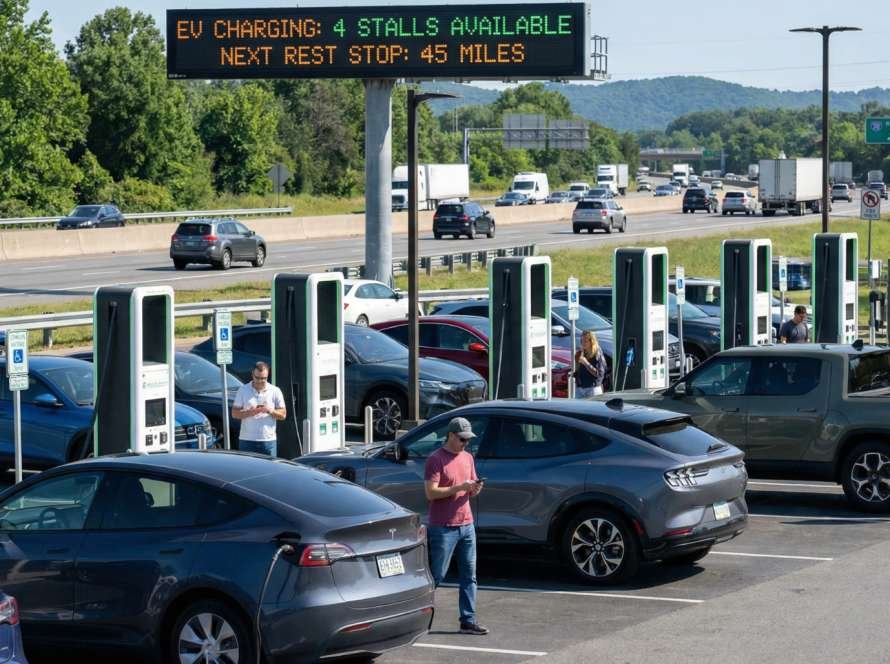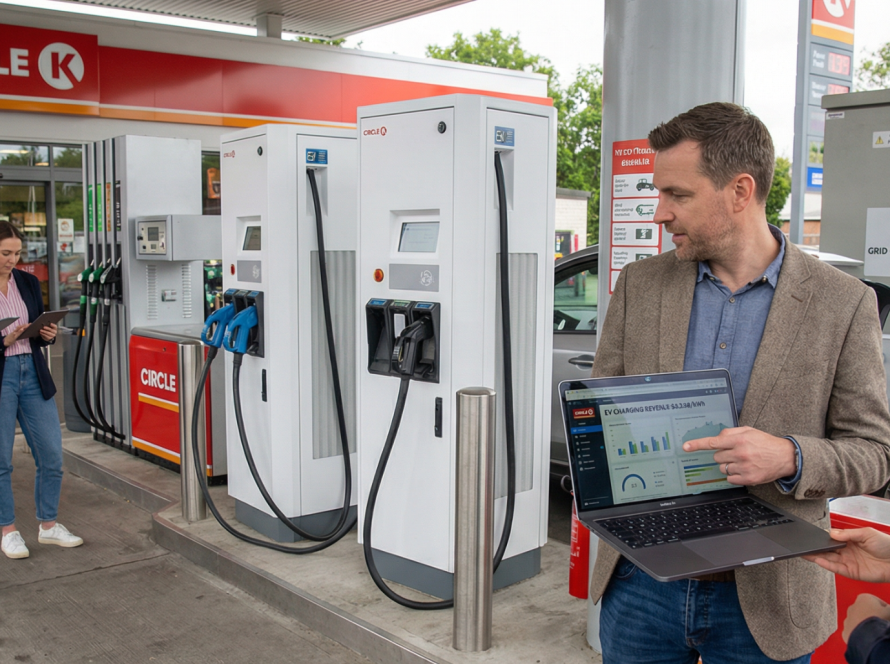
The European EV charging sector crossed a strategic threshold in 2025. What was once a fragmented deployment race has matured into a continent-wide infrastructure buildout, shaped by regulation, capital markets, grid realities, and rapidly evolving user expectations. With 2.5 million new battery-electric vehicles added in a single year and over 18% of new car sales now electric, the charging industry has moved from scale-up to system design.
For executives across mobility, energy, infrastructure, and finance, 2025 was the year the rules of the game changed.
1. AFIR Transforms Charging from Opportunistic to Mandatory Infrastructure
The EU’s Alternative Fuels Infrastructure Regulation (AFIR) came into force as a decisive market-shaping mechanism. Rather than incentivizing deployment, AFIR imposes minimum coverage obligations across the TEN-T corridors.
By 2027, Europe’s core transport arteries must support:
- Passenger EV charging every 60 km, with 600 kW per site
- Multi-bay high-power layouts rather than single-plug installs
- Heavy-duty charging hubs delivering 2.8–3.6 MW, scaling toward 2030
This effectively ends the era of underpowered, symbolic charger installations. For investors and operators, AFIR introduces something the industry lacked for a decade: policy-backed demand certainty. Charging infrastructure is now planned in megawatts, not sockets.
2. Grid Constraints Become the Primary Bottleneck
Despite rapid charger deployment, grid access emerged as the single greatest constraint on growth in 2025. Over 90% of European charge point operators expect grid capacity limitations to slow expansion in the near term.
The response has been pragmatic rather than theoretical:
- Battery-buffered chargers that decouple peak charging demand from grid draw
- Dynamic load management software optimizing available capacity
- On-site renewable generation, especially solar-plus-storage microgrids
Flagship charging hubs increasingly resemble energy systems, not grid endpoints. Tesla’s Oasis Supercharger in California and Europe’s solar-canopy hubs demonstrate where the industry is heading: charging infrastructure that supplements-and sometimes replaces-the grid.
3. Vehicle-to-Grid (V2G) Moves from Pilot to Commercial Reality
After more than a decade of pilots, V2G charging crossed into operational deployment in 2025. Large-scale projects, such as Utrecht’s V2G car-sharing program, now directly support grid stability using bidirectional charging and EV fleets as distributed storage.
Commercial rollouts are accelerating:
- OEMs including Renault, Mercedes-Benz, Hyundai, and Kia now offer V2G-enabled models
- Consumer-ready V2G wall boxes are entering the market
- Software-defined upgrades are unlocking bidirectional capability via OTA updates
The strategic implication is profound: EVs are no longer just loads-they are grid assets. EU estimates suggest V2G could offset up to 25% of grid upgrade investment needs, reshaping energy infrastructure economics.
4. Charging Networks Enter the Era of Institutional Finance and Consolidation
2025 marked a financial inflection point. Leading charging operators secured record-breaking debt financing, signalling that charging networks have matured into bankable infrastructure assets.
Landmark deals included:
- IONITY’s €600 million green loan facility
- Electra’s €433 million financing round, surpassing €1 billion total funding
Notably, these were loan-based financings, not equity raises-evidence that utilization rates and revenue models have stabilized. The logical next phase is consolidation. Well-capitalized operators are positioned to acquire smaller, fragmented networks and drive economies of scale across Europe.
5. Megawatt Charging Redefines Speed and Scale
Ultra-fast charging became standard in 2025-but megawatt charging became inevitable.
Two parallel developments stood out:
- Megawatt Charging Standard (MCS) networks for electric trucks, led by Milence, targeting 1,700 public truck chargers by 2027
- Passenger vehicle charging exceeding 1,000 kW, pioneered by BYD and supported by 1,000-V vehicle architectures
While megawatt charging will not be universal for passenger EVs, it fundamentally resets expectations around dwell time, logistics electrification, and highway infrastructure planning.
6. Driver Experience Becomes a Competitive Differentiator
With power levels converging, experience emerged as the new battleground. Charging operators now compete on:
- Food, retail, and hospitality integration
- Clean, safe, canopy-covered sites
- Work-friendly lounges, Wi-Fi, and brand environment
Premium charging hubs increasingly resemble mobility service destinations, not refuelling stops. This shift directly influences utilization rates, customer loyalty, and long-term network economics.
7. Emerging European Markets Leapfrog Legacy Technology
Central and Eastern European markets demonstrated a strategic advantage in 2025: they skipped outdated infrastructure entirely. Countries scaling EV adoption later deployed:
- 350 kW chargers as the baseline
- Plug & Charge and Auto charge by default
- Fully digital roaming and smart routing from day one
This leapfrogging effect accelerated adoption curves and delivered superior driver experiences without the cost of retrofitting legacy systems.
8. Wireless Charging Enters Commercial Deployment
After years of pilots, wireless EV charging reached production readiness. Porsche’s inductive charging system, launching with the Cayenne Electric, signals a shift from experimentation to consumer offering.
While home wireless charging remains niche, its implications for:
- Fleet vehicles
- Autonomous mobility
- Workplace and depot charging
are substantial. As automation scales, cable-free charging becomes a strategic enabler.
What This Means for 2026 and Beyond
The EV charging industry is no longer about deployment volume-it is about systems integration, capital efficiency, and user experience. In 2026, growth will continue, but differentiation will increasingly come from:
- Grid intelligence rather than raw power
- Financial discipline rather than expansion-at-all-costs
- Experience-led design rather than hardware specs
For executives, the message is clear: EV charging is now core infrastructure, not a peripheral enabler. Those who align strategy with regulation, grid realities, and customer expectations will define the next decade of electric mobility in Europe.